Service Charge vs Gratuity: What You Actually Pay a Caterer in Florida
A service charge is a mandatory fee the caterer sets and counts as its own revenue. A gratuity is a tip, and the amount is up to you. In Miami-Dade the charge is usually taxed. If the contract includes gratuity, you do not need to add a tip on top; if it says nothing, ask in writing before you decide.
If your catering quote in Miami or South Florida shows a service charge of 18% to 25%, you probably want to know where that money goes and whether to tip on top. A $10,000 example near the end shows the totals.
This is general information, not legal or tax advice. Figures were checked in October 2026.
Service charge vs gratuity: what is the difference?
A service charge is set by the business, and a tip is whatever the customer freely chooses to give. Under IRS rules, an automatic gratuity counts as a service charge too, even when it is called a gratuity.
To count as a tip, a payment has to pass four tests in an IRS fact sheet on tips versus service charges. It must be free from compulsion, the customer must set the amount, it must not be negotiated or dictated by employer policy, and generally the customer decides who receives it. If a payment fails any one of them, it may be a service charge instead.
Florida's disclosure law describes a gratuity the same way, as a sum given at the customer's discretion. Florida sales tax uses a different test, explained further down, so one line on a quote can be treated one way for wages and another way for tax.
Service charge vs gratuity: who gets the money?
Under federal wage rules, the caterer does: a service charge counts as the business's revenue, and the business decides how much of it reaches the crew. A voluntary tip belongs to the staff.
Under the federal Fair Labor Standards Act, an employer cannot keep tips its employees receive, and managers cannot take a share. A compulsory service charge is not a tip under federal wage rules, so an employer may count the part it pays to staff toward the wages it owes under federal law.
Some employers keep part of a service charge, and the IRS acknowledges this. In 2022 the Eleventh Circuit, the federal appeals court that covers Florida, looked at a Miami restaurant's mandatory 18% charge. It decided the charge was not a tip and could count toward the restaurant's wage bill.
A service charge line tells you what the business bills. How much of it a server takes home is a separate question for the caterer.
What does a service charge pay for, and what is typical in Miami?
MIAFTA, the Miami Food Truck Association, lists Miami catering service charges at 18% to 25% of the food and beverage total on its own cost page. Caterers and venues describe the fee as covering costs such as setup, cleanup, insurance and administration, and in some cases part of staff wages.
MIAFTA's 2026 catering cost page describes the charge as an operational fee for the caterer, separate from a staff gratuity. A national caterer says 18% to 22% covers insurance, advertising and admin staff, and a caterer in the Washington, DC area says 15% to 25% covers staffing, setup and cleanup. A Seattle event venue calls 18% to 26% typical and says its charge covers only part of staff wages in most cases.
In Miami, one BBQ caterer's rate falls with event size, 18% for 50 to 100 guests and 10% for 300+ guests, and one wedding caterer lists 22% beside its package price. Both are broken down in how much catering costs in Miami.
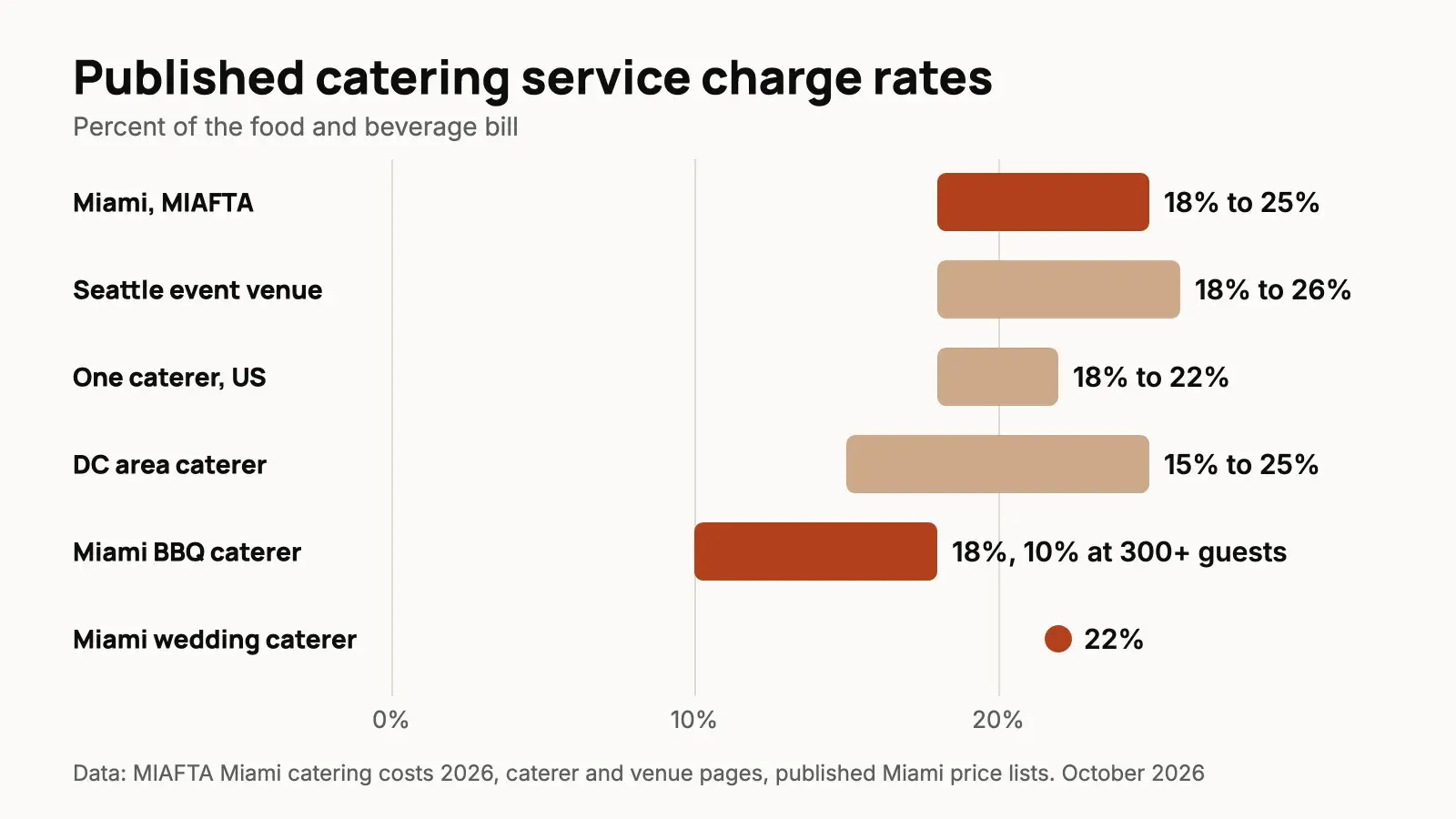
When you compare quotes for full-service catering in Miami, line up the charge percentage next to the food price for each company.

What does Florida's 2026 law require a food business to disclose?
Since July 1, 2026, a Florida public food service establishment that adds an automatic fee must show its amount or percentage and what it is for. The notice goes on the menu, the written contract, and the ordering website or app, as applicable.
The law, section 509.214, calls such a fee an operations charge: any automatic fee, other than a tax, that you must pay on top of the food and beverage cost. That covers service charges and automatic gratuities. For a catering contract, these details matter:
- Size of the notice. It must be at least as large as the font for menu descriptions or, in a written contract, the general terms.
- On the bill. The bill must say on its face that an operations charge is included.
- Automatic gratuity. If the operations charge includes one, the receipt must list it separately.
- Fixed-price packages. The section does not apply to a package or fixed-price meal whose price is disclosed before you buy.
- Enforcement. A customer cannot sue under this section alone. The state's Division of Hotels and Restaurants can fine a business up to $1,000 per offense under section 509.261 and can suspend or revoke its license.
Florida's definition of a public food service establishment includes a place that prepares food for delivery elsewhere. Ask the caterer whether it is licensed as one.
Is a service charge taxed in Florida?
Usually yes. Florida taxes a service charge on food as part of the sales price. A gratuity escapes the tax only when it sits on its own line of the receipt and the business gets none of the money.
Florida's tax rule, Rule 12A-1.0115, taxes service charges, setup fees and similar charges a business adds when it prepares or serves food. It treats any gratuity or tip charge as part of the taxable price unless the receipt lists it separately and the business gets no monetary benefit from it.
In a 2014 ruling for one business, TAA 14A-024, the Department of Revenue looked at a 10% gratuity listed on its own line. The customer could adjust it, all of it went to employees, and the Department found it was outside the taxable price. That ruling applies to the business that asked. Whether your caterer's setup passes the test is a question for the Department of Revenue or a tax adviser.
If a caterer says its charge goes fully to staff, ask two things in writing: is it listed on the receipt as a gratuity, and does the business keep any of it? A line labeled service charge is generally taxed.
The rate in Miami-Dade is 7%, Florida's 6% plus a 1% county surtax, according to a 2026 table of county rates from a Florida sales tax blog.
How much does a service charge add to a Miami catering bill?
On a $10,000 food and beverage bill in Miami-Dade, a 20% service charge and 7% tax bring the total to $12,840. Because the charge is taxed too, it adds 21.4% to the food bill.
Here is how that quote adds up: food and beverage $10,000.00, service charge at 20% $2,000.00, sales tax at 7% $840.00, total $12,840.00. The table below compares six cases.
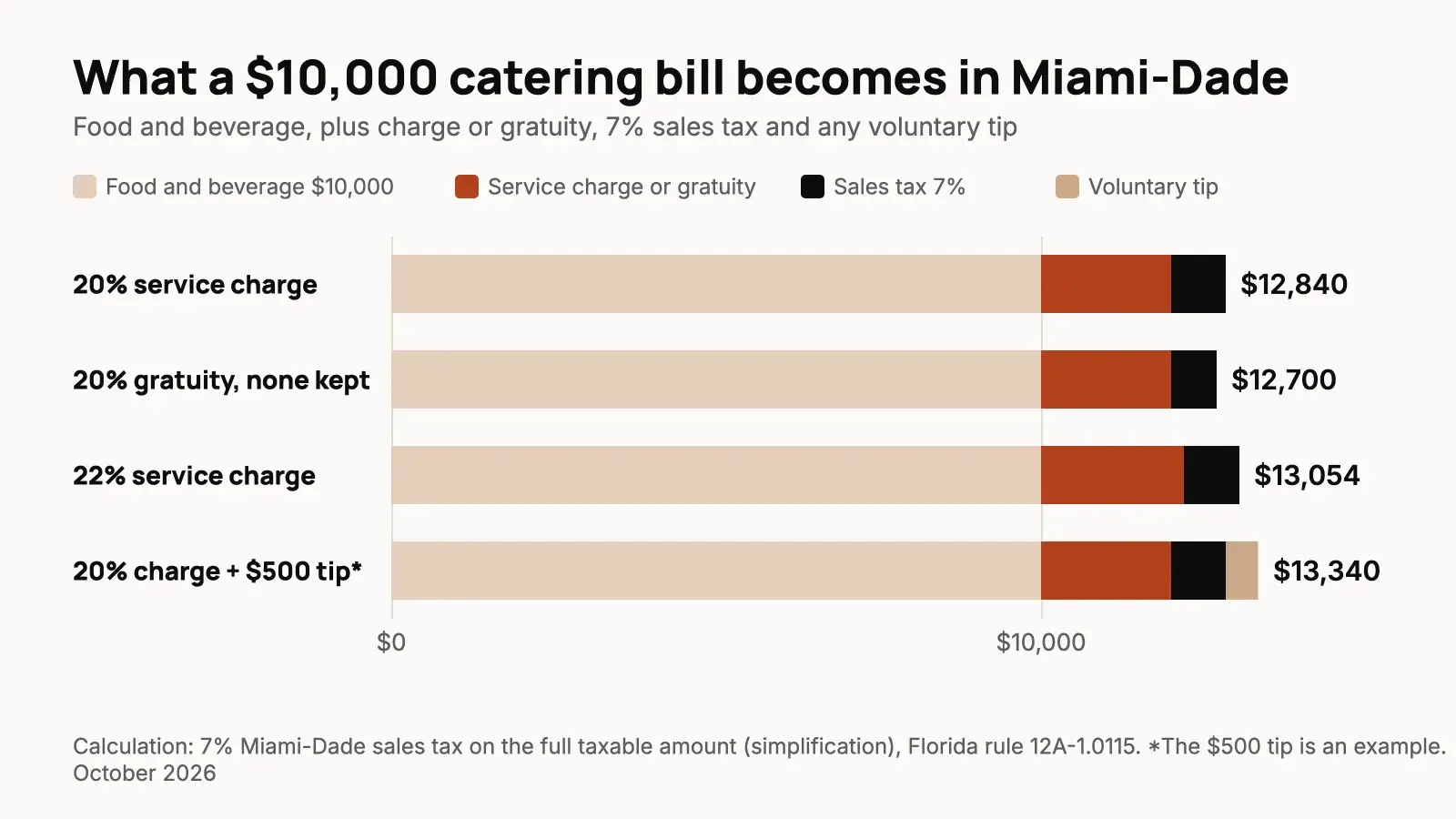
If your quote says service charge, use the service charge rows. The gratuity row holds only when the receipt lists it on its own line and the business keeps none of it; otherwise a 20% gratuity lands at $12,840, like a service charge.
The $500 tip is an example, paid outside the bill and untaxed. The example has food and one charge line only, and it applies 7% to the whole taxable amount as a simplification. Staffing, rental or delivery lines on your own quote can change the result.
A 22% charge costs $2,200 plus tax, or $2,354, which is 23.54% of the food bill.
Should you tip on top of a service charge?
A tip is up to you by definition. If the contract says gratuity is included, the tip is covered. If it says gratuity is not included, or says nothing, confirm in writing and then decide the amount yourself.
Check the contract first. Some caterers write gratuity into the service fee, so the tip may already be covered, according to Zola, a wedding planning site. One Miami caterer states on its menu that tip or gratuity is not included.
When gratuity is not included, Zola gives two methods for weddings:
- A percentage. 15% to 20% of the total food and drink bill, which is $1,500 to $2,000 on $10,000, and 10% to 15% of the bar bill for bartenders.
- Flat amounts. $200 to $300 for the catering manager, $20 to $30 for each server and $50 to $100 for chefs and kitchen staff.
Zola's ranges are written for a contract with no gratuity in it. Ask how much of the charge reaches the crew before you decide. Zola also suggests giving the sum to the catering manager to hand out.
If you are booking wedding catering in Miami, agree on the tip when you sign the contract. The average cost of wedding catering shows where it fits in a full budget.

Mistakes to avoid and what to check before you sign
Two things throw off a quote comparison: assuming every 20% line costs the same, and looking only at food prices.
- Assuming every 20% line costs the same. A 20% gratuity that meets the tax test and a 20% service charge differ by the tax shown in the table.
- Looking only at food prices. For the same $10,000 of food, a 22% charge costs $214 more than a 20% charge. Put the percentage next to the per-guest price for every quote.
Open your quote and look for five things:
- Is the service charge on its own line, with a percentage and a dollar amount?
- Does the quote say what the charge covers?
- Does it say whether any of the charge goes to the staff who work your event?
- Does it say whether gratuity is included?
- Are sales tax and the final total on separate lines?
If an answer is missing, you can send this: "Could you update our quote so the service charge shows its percentage and what it covers? Please also say whether any of it goes to the event staff and whether gratuity is included, and show sales tax and the total on separate lines."
Frequently asked questions
Can I refuse to pay a service charge?
Usually not once you sign. A service charge is a term of the quote, so the time to question it is before you sign. Florida's disclosure law requires a covered business to state the amount and purpose in the written contract. That lets you see what you are agreeing to and ask the caterer about the rate.
Is gratuity included in catering?
It depends on the caterer. Some write gratuity into the contract or add it automatically, and others expect a tip on top, as a caterer in the Washington, DC area notes. A line called service charge does not by itself mean the crew is tipped. Ask in writing, and until someone confirms it, plan to decide a tip yourself.
Does a service charge count as a tip for the federal tax deduction on tips?
No. Only voluntary tips qualify for the federal deduction, which is capped at $25,000 per year for 2025 through 2028. IRS final regulations in Internal Revenue Bulletin 2026-18 say automatic gratuities, such as service charges, are not qualified tips. The deduction belongs to the worker who receives the tips.
Is an administrative fee the same as a service charge?
Not automatically, since the label does not decide it. Florida's definition of an operations charge covers any automatic fee you must pay on top of the food and beverage cost, and it is not limited to service charges. An administrative fee you must pay would likely fit. Ask what it covers and who receives it.
27.10.2026